
difference between the available care options for Special Adult
Residential Care vs Day Care vs Respite Care for Special Needs Adults: Which Does Your Family Need?
When a family starts searching for support for an adult with Down Syndrome, Cerebral Palsy, or Severe Learning Disability, the first challenge is usually understanding the difference between the available care options. Terms like residential care, day care, respite care, and permanent home placement are often mixed together, even though each one serves a different need.
This guide explains each option in simple language so families in Gurgaon, Gurugram, Delhi, and across NCR can choose the right level of care with confidence.
Residential care means full-time living with daily supervision. Day care means structured support during the day, with the person returning home in the evening. Respite care is short-term stay support so caregivers can rest or manage temporary needs. Permanent home placement means long-term or lifelong residential living for future security.
What Families Commonly Tell Us Before Choosing Additional Support
Many families begin their search believing they need one specific service, such as residential care or respite care. However, once they look closely at their loved one’s daily routine, support needs, and future planning concerns, they often discover that several options may be suitable.
Some families contact us because caregiving has become physically demanding. Others are looking for more structure and social engagement during the day. Many are simply trying to answer an important question: “What happens when we are no longer able to provide care ourselves?”
The right care option is rarely determined by diagnosis alone. It depends on the individual’s abilities, support requirements, health needs, daily living skills, and family circumstances.
Taking time to understand these factors often leads to a more confident and sustainable care decision.
Key Takeaways
- The right option depends on the person’s daily support needs, not just the diagnosis.
- Day care is best when the adult still lives at home but needs structure and supervision during the day.
- Respite care helps families manage burnout, travel, emergencies, or short breaks.
- Residential care is for adults who need ongoing daily support and a stable living environment.
- Permanent home placement is a future-planning decision for lifelong security and continuity.
Quick Decision Guide
| Option | Best for | Duration | Where the person stays |
|---|---|---|---|
| Residential care | Adults needing ongoing supervision and support | Long-term | Care home full-time |
| Day care | Adults who need daytime structure | Daily | Home at night |
| Respite care | Families needing a short break or temporary help | Days to weeks | Care home temporarily |
| Permanent home | Families planning lifelong security | Open-ended / lifelong | Care home long-term |
Residential care means the person lives in the care home full-time and receives daily supervision, personal care, routine support, and help with day-to-day living. It is meant for adults who need ongoing structured support and a stable environment.
Residential care is usually the right choice when:
- The individual needs 24-hour supervision,
- The family cannot safely manage care at home anymore,
- Daily personal care, mobility support, or behaviour support has become difficult at home,
- The family is planning for a long-term or permanent arrangement.
For many families, residential care becomes the best option when the goal is not just support, but stability, dignity, and continuity.
What Is Day Care for Adults with Disabilities?
Day care means the person spends the day at the care centre and returns home in the evening. It gives structured activity, supervision, social interaction, and engagement without overnight stay.
Day care is useful when:
- the adult still lives at home with family,
- the family needs daytime support,
- the person benefits from routine and structured activity,
- the family is not yet ready for full residential placement.
Day care often works well as a bridge between full home care and residential care. It also helps the adult get used to a structured environment before a bigger transition.
What Is Respite Care for Special Needs Adults?
Respite care is a short-term planned stay at a residential facility. It gives family caregivers a break while the individual is safely cared for in a structured environment.
Respite care is useful when:
- the caregiver needs rest or recovery,
- the family is travelling or managing a temporary situation,
- the family wants a short trial stay before a longer placement,
- extra support is needed for a limited period.
Respite care is not only for emergencies. In many families, it becomes an important part of long-term caregiving because it prevents burnout and helps the family sustain care over time.
What Is a Permanent Home Placement?
A permanent home placement means the person lives in the care home on a long-term or lifelong basis. This is different from short respite stays or day care attendance.
It usually becomes relevant when:
- parents are ageing,
- the family is thinking ahead about long-term security,
- home-based care is no longer sustainable,
- the family wants a stable “what after us” plan.
This is often an emotional decision, but for many families it is also a practical and loving one. A permanent home is not about giving up, it is about planning responsibly for lifelong care.
Which Option Fits Down Syndrome, Cerebral Palsy, and Severe Learning Disability?
All three conditions can require different levels of support depending on the person’s age, mobility, health, communication, and daily routine needs.
Down Syndrome: Some adults need only daytime support for activity and structure, while others may need residential care as health and dependence increase with age.
Cerebral Palsy: Support needs often depend on mobility, physical assistance, and supervision. Residential care or respite care may be needed when home care becomes physically difficult.
Severe Learning Disability: Many adults with severe learning disability benefit from structured residential care, especially when daily supervision and long-term planning become necessary.
The same diagnosis does not mean the same care plan. The right option depends on the individual.
Signs It May Be Time to Consider Additional Support
Families often begin thinking about more support when home care starts to feel stretched. Common signs include:
Personal care and daily living support
- the person needs more supervision than the family can safely provide,
- daily routine is becoming difficult to maintain,
- caregivers are physically or emotionally exhausted,
- personal care, meals, mobility, or behaviour support have become harder to manage,
- the family is asking more often, “What happens when we are no longer able to do this?”
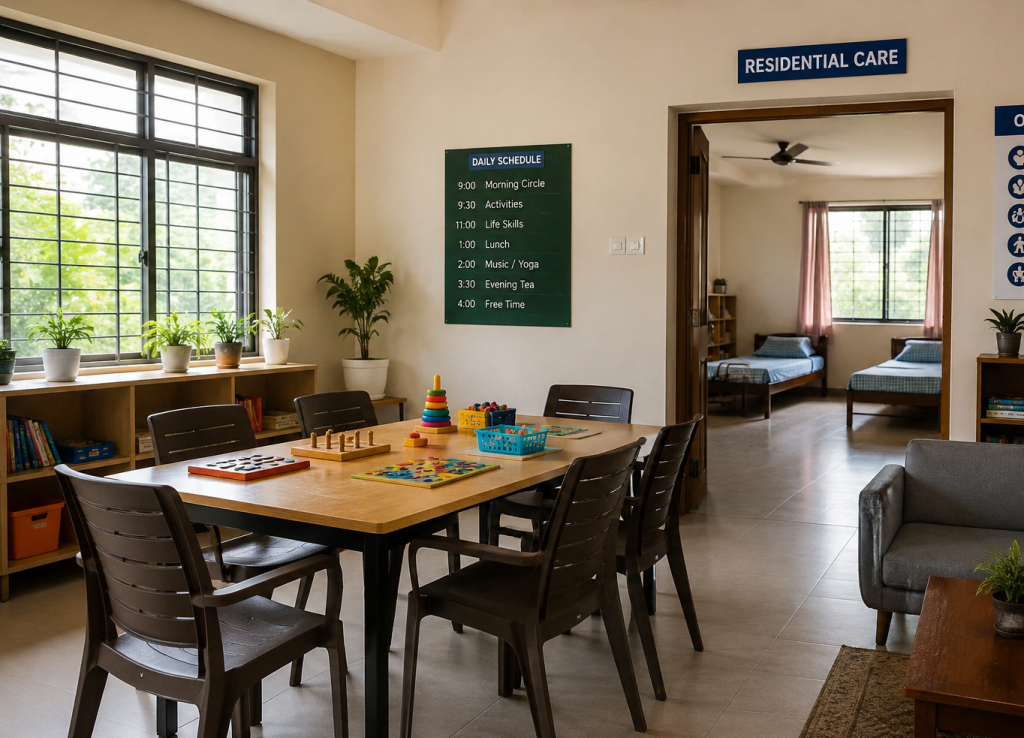
These signs do not mean home care has failed. They usually mean the family needs a better support model.
Questions Families Should Ask Before Choosing a Care Home
Before deciding, ask:
- Can the family continue overnight supervision safely?
- Is the adult getting enough structure at home?
- Is the caregiver under stress or burnout?
- Is there a future care plan in place?
- Would a short stay help the adult adjust to a new routine?
If the answer points to daytime support, day care may be enough. If the family needs a break, respite care is the better fit. If full-time support is needed, residential care makes more sense. If lifelong planning is the goal, a permanent home conversation should begin now.
A Simple Care Planning Checklist
Families may benefit from exploring additional support if several of the following statements are true:
- The adult requires supervision for most daily activities.
- Caregiving responsibilities are becoming physically or emotionally difficult for family members.
- Overnight supervision is becoming harder to manage safely.
- The person would benefit from a more structured environment and regular routine.
- There is growing concern about long-term care planning and future security.
- The family is experiencing caregiver stress or burnout.
- The individual would benefit from increased opportunities for social interaction and community participation.
The more items that apply, the more important it may be to explore day care, respite care, residential care, or long-term support options.
Common Mistakes Families Make When Comparing Care Options
- Choosing based on the name of the service instead of the person’s actual needs.
- Comparing a special needs care home with an elderly care facility.
- Thinking respite care is only for emergencies.
- Delaying planning until a crisis happens.
- Assuming one diagnosis automatically means one type of care.
A good decision starts with the person’s routine, support needs, communication style, mobility, and future care needs.
How Care Needs Can Change Over Time
Care needs are not fixed. An adult with Down Syndrome may need more support as health needs increase with age. An adult with Cerebral Palsy may need changing support depending on mobility and physical comfort. An adult with Severe Learning Disability may need more structure, supervision, and daily assistance over time.
That is why many families begin with day care, move to respite care when needed, and later consider residential care or permanent placement. A good care plan should allow for this kind of transition.
Why Families in Gurgaon and NCR Search for These Options
Families across Gurgaon, Gurugram, Delhi, Noida, Faridabad, and Ghaziabad often search for these care options when home care reaches its limit. In many cases, the search begins with uncertainty, then becomes a need for clarity, safety, and long-term planning.
The right care home should not just offer a bed or a schedule. It should offer structure, trust, communication, and a clear plan for the future.
Planning for the “What After Us?” Question
For many families, the biggest concern is not today — it is the future. Parents often ask who will care for their adult child when they are no longer able to do so.
That is where permanent home placement and long-term care planning become important. A thoughtful plan may include:
- residential care,
- legal guardianship,
- financial planning,
- family involvement,
- and regular care review.
This is not a one-time decision. It is a family planning process.
Understanding Supported Living and Long-Term Care Planning
When families compare residential care, day care, and respite care, they are often also exploring broader concepts such as supported living and long-term care planning.
Supported living refers to services and environments that help adults with disabilities maintain as much independence as possible while receiving appropriate support. Depending on the individual’s needs, this may include assistance with daily living activities, mobility, communication, medication management, social engagement, and personal care.
Long-term care planning focuses on ensuring continuity of care over many years. This planning often includes future housing arrangements, family involvement, financial planning, legal considerations, and identifying the support services that may be needed as circumstances change.
For many families, exploring care options is not simply about meeting today’s needs. It is also about creating a stable and sustainable plan for the future.
Common Questions
Frequently Asked Questions
Quick answers to the most common questions families ask about
Different care facility.
What is the difference between residential care and day care?
Residential care is full-time living in the care home. Day care is only for daytime support, after which the person returns home.
What is the difference between respite care and residential care?
Respite care is temporary. Residential care is long-term or permanent.
Can a family start with day care and later move to residential care?
Yes. Many families begin with day care and later transition to residential care when support needs increase.
Is permanent home placement the same as residential care?
Permanent home placement is a type of long-term residential care, but the emphasis is on lifelong or open-ended planning.
Which option is best for an adult with Severe Learning Disability?
It depends on the person’s support needs, but many adults with severe learning disability benefit from structured residential care.
What happens when parents can no longer provide care?
That is when families usually need a future care plan, which may include residential care, legal guardianship, and long-term placement planning.
What is the best option for residential care for adults with Down Syndrome?
It depends on the individual’s support needs, age, health, and daily routine. Some adults may do well with day care first, while others need residential support.
Is respite care helpful for adults with Cerebral Palsy?
Yes. Respite care can be helpful when the family caregiver needs a break or when temporary support is needed.
Need Help Understanding the Right Care Option?
Every individual and every family situation is different. Choosing between day care, respite care, residential care, or long-term placement depends on the person’s support needs, daily routine, health considerations, and future planning goals.
If you are exploring care options for an adult with Down Syndrome, Cerebral Palsy, or Severe Learning Disability, speaking with an experienced care team can help bring clarity to the decision-making process.
Contact Saksham by Kriti to discuss your family’s situation and understand which support option may be most appropriate for your loved one.
Review Information
The information in this article is based on established disability care principles, long-term support planning practices, and guidance from recognized organizations working in disability services and inclusion.
- World Health Organization (WHO). Disability and Health.
- United Nations Convention on the Rights of Persons with Disabilities (UNCRPD).
- National Institute for Empowerment of Persons with Intellectual Disabilities (NIEPID), India.
- Ministry of Social Justice and Empowerment, Government of India – Disability Support Programmes.
National Trust, - Government of India – Support Services for Persons with Autism, Cerebral Palsy, Intellectual Disabilities, and Multiple Disabilities.
References and Further Reading
This article has been reviewed by the multidisciplinary care team at Saksham by Kriti, which supports adults with Down Syndrome, Cerebral Palsy, and Severe Learning Disabilities through residential care, day care, respite care, and long-term care planning in Gurugram.
Our Disability Care Services
Saksham By Kriti offers disability care services that respond to different stages of family need. Some families may begin with day care, others may need respite care during a period of transition, and others may be actively exploring special needs residential care or long-term disability care for an adult loved one.

Respite Care for Disabled Adults in Gurgaon
For adults with intellectual disabilities, cerebral palsy, Down syndrome, or severe learning disabilities, respite care means staying in a structured, familiar-style environment with experienced care staff, while their family rests, travels, manages medical needs, or takes time for their own wellbeing.

Day care for adults with disabilities Gurgaon
Saksham by Kriti offers structured day care for adults with intellectual disabilities, cerebral palsy & special needs in Gurgaon. Mon–Sut. Enquire now.

What After Us
At Saksham By Kriti, we understand that this question comes from care, not from guilt. Families who think about future support are not stepping away from responsibility. They are planning with courage and compassion for the long-term wellbeing of someone they love.
If you are exploring day care, respite care, residential support, or long-term planning, the next step is to contact the team directly.