

Special Needs Education Near me : The Comprehensive Parent’s Guide to Choosing the Right School
If you’re searching for the right special needs education near me support for a child with developmental, learning, behavioral, or communication needs, you’ve probably already discovered how confusing the landscape can be. Every school claims individualized care, every brochure sounds reassuring, and yet the most important question often remains unanswered: Will this actually work for my child? In this guide, we explain exactly how special needs education works in India, what your legal rights are, how to compare programs, and how to confidently choose the right educational path.
Table of Contents
- Key Takeaways
- What Is Special Needs Education?
- Why Special Needs Education Matters in india
- Legal Rights for Children With Special Needs in India
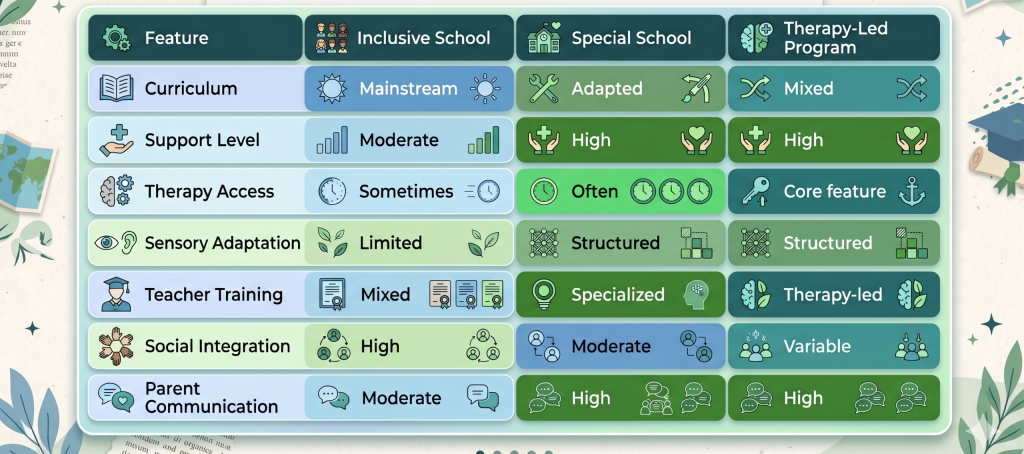
- Inclusive School vs Special School vs
- Therapy-Led Programs
- What Is an IEP and How
- Do Parents in India Get One?
- Shadow Teacher vs Special Educator
- At What Age Should Special Needs Education Begin?
- How Much Does Special Needs Education Cost in India?
- Best Cities for Special Needs Education in India
- How to Evaluate a Special Needs Program
- FAQ
Key Takeaways
- Special needs education in India is legally protected under the RPwD Act 2016.
- RCI-certified professionals are an important quality benchmark for parents.
- IEPs help personalize learning goals, therapies, and progress tracking.
- Inclusive schools and specialized schools serve different child profiles.
- Early intervention significantly improves developmental outcomes.
- Therapy integration often produces stronger real-world learning progress.
- Choosing the right fit matters more than choosing the nearest option.
What Is Special Needs Education?
Special needs education is an individualized educational approach designed for children who need adapted teaching methods, therapeutic support, assistive communication, behavioral scaffolding, or structured developmental learning.
In India, this often falls under the umbrella term Children With Special Needs (CwSN), widely used in education and policy frameworks.
For example, a 6-year-old child in Gurugram with autism who struggles with transitions and sensory overload may find a conventional classroom overwhelming, but thrive in a structured environment with visual schedules, sensory supports, and trained intervention staff.
According to UNESCO, more than 240 million children globally live with disabilities.
Special needs education may support children with:
- Autism Spectrum Disorder (ASD)
- ADHD
- Dyslexia
- Learning Disabilities
- Intellectual Disabilities
- Down Syndrome
- Cerebral Palsy
- Speech Delays
- Sensory Processing Challenges
- Emotional Regulation Needs
- Multiple Disabilities
Special needs education is not about limitation, it is about educational access through adaptation.
Why Special Needs Education Matters in India
Special needs education matters because enrollment alone does not guarantee meaningful learning participation.
A child may technically be “in school” but still remain excluded academically, emotionally, or socially if the environment is not appropriate.
India’s UDISE+ education reporting system has documented over 2 million Children With Special Needs enrolled in school systems, showing both rising access and rising demand for structured support.
Yet access does not automatically equal effective intervention.
For example, a child with ADHD in a large classroom may appear inattentive or disruptive, when the actual issue is environmental mismatch, not unwillingness to learn.
Access without meaningful support is not inclusion.
Legal Rights for Children With Special Needs in India
Special needs education in India is backed by legal and policy frameworks that parents should understand before choosing a school
RPwD Act 2016
The Rights of Persons with Disabilities Act, 2016 legally protects educational access and inclusion.
Section 16 requires institutions to ensure:
- non-discrimination
- inclusive education
- barrier-free access
- reasonable accommodations
- participation support
This is a critical protection for families.
NEP 2020
India’s National Education Policy 2020 emphasizes equitable education for all learners, including children with disabilities.
It supports:
- inclusive classrooms
- teacher training
- assistive learning
- individualized support
- disability inclusion reform
Rehabilitation Council of India (RCI)
The Rehabilitation Council of India regulates training and certification for rehabilitation professionals.
Parents should ask directly:
“Are your special educators RCI-certified?”
Because teacher qualification significantly impacts educational outcomes.
CBSE Inclusion Guidelines
CBSE encourages inclusive learning frameworks, support educators, accommodations, and adaptive educational participation.
Benchmark PTR expectations commonly referenced:
- 1:10 for higher-support primary support settings
- 1:15 for upper-level structured support settings
Use these as practical evaluation benchmarks.
Inclusive School vs Special School vs Therapy-Led Programs
Different children need different support intensity.

Parent Scenario
A 7-year-old with mild dyslexia may thrive in an inclusive school with accommodations.
A child with autism needing speech therapy, sensory regulation, and structured transitions may benefit more from specialized programming.
A child with developmental delay needing multidisciplinary intervention may progress best in therapy-led education.
There is no universally “best” model, only the best fit.
What Is an IEP and How Do Parents in India Get One?
An Individualized Education Program (IEP) is a structured educational roadmap tailored to a child’s learning, developmental, and support needs.
A strong IEP includes:
- academic goals
- behavioral goals
- communication milestones
- therapy objectives
- classroom accommodations
- review timelines
- parent collaboration
How Indian Parents Can Request an IEP
Ask the institution:
- Do you create written
- individualized learning plans?
- How frequently are goals reviewed?
- Who designs the plan?
- Are therapists involved?
- Are parents included?
Even where “IEP” is not formally named, strong programs should offer equivalent individualized planning.
At What Age Should Special Needs Education Begin?
Special needs education near me should begin as early as developmental differences become functionally relevant.
Earlier intervention generally produces better outcomes.
NIH and developmental research consistently support early structured intervention.
Broad guidance:
Age | Recommended Focus |
0–3 | Early intervention |
3–6 | Foundational developmental learning |
6–12 | Structured academic + therapy integration |
12+ | Functional independence + adaptive education |
Waiting for children to “grow out of it” often delays progress.
How Much Does Special Needs Education Cost in India?
Costs vary widely.
Approximate ranges:
Program Type | Monthly Cost (India) |
Inclusive school with accommodations | ₹8,000–₹25,000+ |
Specialized private school | ₹15,000–₹60,000+ |
Therapy-led education | ₹20,000–₹80,000+ |
Shadow teacher support | ₹15,000–₹50,000+ |
Additional costs:
- assessments
- transport
- therapy
- assistive tools
- one-on-one aides
How to Evaluate a Special Needs Program
Use structured evaluation, not emotional marketing.
Parent Evaluation Scorecard (Example)
Criteria | Benchmark Score Example |
Staff Credentials | 9/10 |
RCI Certification | 10/10 |
Therapy Integration | 8/10 |
Safety | 9/10 |
Parent Communication | 8/10 |
Emotional Environment | 9/10 |
PTR | 8/10 |
Cost Transparency | 7/10 |
School Visit Checklist
Observe:
- classroom transitions
- staff interaction
- child comfort
- sensory supports
- therapy coordination
- Communication systems
- safety process
Frequently Asked Questions
What is the pupil-teacher ratio for special education near me?
Practical support benchmarks commonly referenced are around 1:10 to 1:15 depending on setting intensity.
What is the difference between a shadow teacher and a special educator?
Shadow teachers provide day-to-day classroom support, while special educators design and deliver adapted learning interventions.
How do I get an IEP made for my child in India?
Ask your school or program for a written individualized education plan with measurable goals and review cycles.
At what age should special needs education begin?
As early as functional developmental differences are identified.
Are special needs education costs covered by government schemes?
Coverage varies. Some disability support schemes may help, but private programs are usually parent-funded.
What does UDISE+ track?
UDISE+ tracks school education data including CwSN participation metrics.
Can a child move from special school to mainstream school?
Yes, depending on developmental readiness, support needs, and transition planning.
What is the role of RCI?
RCI regulates training and certification standards for rehabilitation professionals.
Conclusion
Special needs education is not about labels.
It is about educational fit, developmental support, emotional safety, and long-term independence.
The right environment can change how a child learns, communicates, and experiences confidence.
If you are exploring structured support through Saksham by Kriti, the most useful first step is not asking “Is this the best school?”
It is asking:
“Is this the right fit for my child?”
Insights & Resources

Activities for Adults With Disabilities: Meaningful Daily Routines & Ideas
Discover meaningful activities for adults with disabilities, from physical, creative and cognitive activities to social and life-skills activities. Learn how personalised daily routines can support choice, participation and independence.
Can Adults With Cerebral Palsy Live Independently? A Guide to Supported Living, Residential Care, and Future Planning
When your child with a developmental disability transitions from a teenager into a young adult, the quiet comfort of childhood routines is often replaced by a pressing, deeply emotional question: What happens when they turn 18 and face the world as an adult? For parents navigating this specific life-stage anxiety, it is entirely common to feel overwhelmed by the long-term choices ahead.

Cost of Residential Care for Disabled Adults in Gurgaon (2026 Guide)
Wondering how much residential care costs for adults with disabilities in Gurgaon? This 2026 guide breaks down monthly fees, deposits, what’s included, and how to compare care homes in Delhi NCR.

Supported Living vs Residential Care: Which Is Right for Adults with Disabilities?
A clear guide for families comparing supported living and residential care for adults with disabilities in Gurgaon, Gurugram, and Delhi NCR.

Care Homes for Disabled Adults Near Me: A Complete Guide for Families in Gurgaon, Delhi NCR, Noida & Faridabad
Choosing the right care home for a disabled adult in Delhi NCR can feel overwhelming. This guide explains what to look for and how Saksham by Kriti in Gurugram supports families from Delhi, Noida, Faridabad, Ghaziabad, Sohna, Greater Noida, and across the NCR with compassionate long-term residential care.

Signs It’s Time to Consider Residential Care for Your Adult Child with Disabilities
Residential care may be the right option when your adult child with disabilities requires ongoing supervision, structured daily support, assistance with everyday living, or when family caregiving is becoming difficult to sustain safely. The decision is based on the individual’s support needs, quality of life, and long-term care planning rather than a single event or diagnosis.
Special Needs Education in India: The Comprehensive Parent’s Guide to Choosing the Right School
Special Needs Education Near me : The Comprehensive Parent’s Guide to Choosing the Right School If you’re searching for the right special needs education near
Mentally Disabled vs Intellectually Disabled: Key Differences
Many families searching for care options in India use the words “mentally disabled” and “intellectually disabled” in the same way. In everyday conversation, that is common. But clinically and in care planning, these terms do not mean the same thing.
Residential Care vs Day Care vs Respite Care for Special Needs Adults: Which Does Your Family Need?
Compare residential care, day care, respite care, and permanent home options for adults with Down Syndrome, Cerebral Palsy, and Severe Learning Disabilities.

Understanding Long-Term Care Options for Cerebral Palsy
A comprehensive guide to residential care, therapeutic interventions, and what families should look for in a specialised facility. When a family member is diagnosed with